Showing posts with label RT320. Show all posts

Tuesday, September 09, 2014

Clansman PRC320 repair

The Clansman PRC320 HF radio that I recently blogged about has been in my workshop for repair this week. It failed when I took it on holiday early in August, but I hadn't had time to fix it until now.

The set appeared completely dead and wouldn't power up, even though I tried two freshly charged batteries.
It turned out that a screw had worked loose, and it had ended up being lodged between the +24V battery input terminal and the chassis.
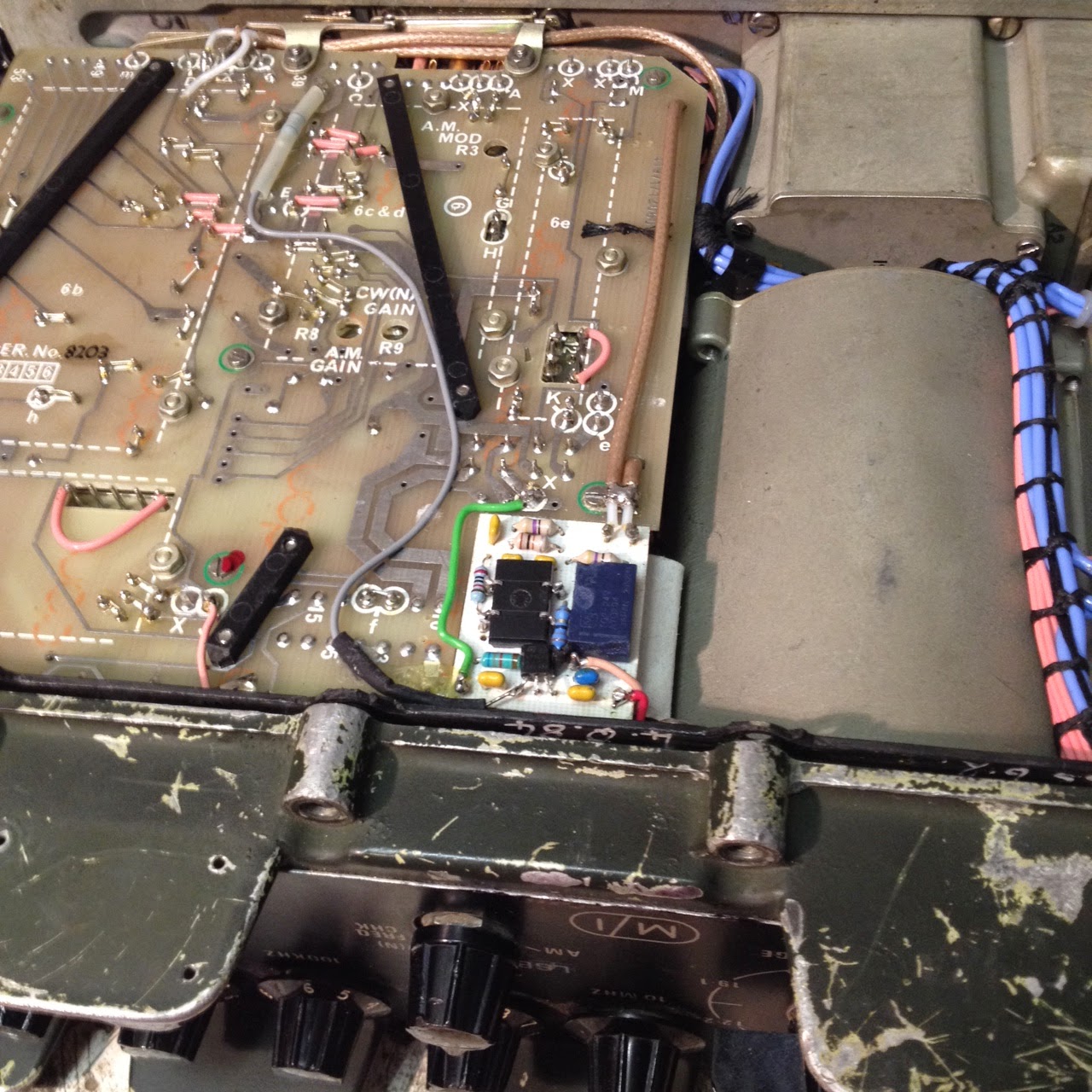
PRC320 main PCB, with LSB modification  installed

The offending screw was one of the PCB securing screws which are identified with a green circle on the PCB silkscreen. Its now back in place, centre left of the photo above, and secured with a dab of the wife's red nail varnish.

The little white PCB in the photo above is the LSB modification that I recently fitted. I might detail this in a blog some other time.

If you open up one of these sets yourself it would be a good idea to check all the screws for tightness. Quite a few were loose in mine, along with the nuts securing the BNC sockets on the rear panel.

I later discovered that the dead short had taken out both of the batteries. It appears that they have an internal fuse (probably a good idea if one is going to put a dead short across a large pack of NiCd cells) but unfortunately it is buried deep between the cells where it is inaccessible.

Clansman 24V 4Ah NiCd battery

The battery packs were the later all plastic types and arent meant to be opened, but I was able to prise the bottom off of one of them. I exposed the bottom layer of cells by digging out some of the foam that surrounds them, but I didn't think I would get any further without damaging either the cells or the plastic case.

The thin red and black wires in the centre of the pack are from one of the temperature sensors used by the charger.

I've still got one good battery pack left. That should keep me going for now, but in the longer term I'll either have to buy some more, or come up with and alternative form of battery.

Keep listening!


Sunday, July 20, 2014

Clansman military radios

Clansman was the name given to a Combat Radio System used by the UK armed forces from the late '70s to around 2009, when it was replaced by the current Bowman system. It comprised a range of man portable and vehicle mounted radios in the HF (2 - 30MHz), VHF (30 - 76MHz) and UHF (225 - 400MHz) frequency bands.

The HF and VHF versions are of interest to radio amateurs for the HF, 6M and 4M bands and are becoming very collectable. The UHF kit is AM only, and has no real amateur radio application. Disposals by the Ministry of Defence have now ceased and inevitably the price of available kit has begun to rise significantly. 

I acquired my first Clansman radio, a PRC320 HF man-pack, around a year ago. It's an excellent piece of kit, although it is heavy and somewhat basic compared to commercial and amateur transceivers. It is however extremely rugged and can be thrown around, used in the pouring rain or have beer spilled on it without suffering any damage.

A PRC320 similar to mine, with whip antenna connected.
The PRC320 was primarily designed as a man portable radio but it could also be installed into vehicles. The original military uses were to provide ground wave communications over short distances using either the whip antenna or an end-fed vertical, or sky wave communications over greater distances using a dipole.

The built in Antenna Tuning Unit is somewhat limited and will only work with the whip or end fed wire antenna. Dipole antennas are assumed to be resonant on the frequency in use; these are connected directly to the transceiver, bypassing the built in ATU.

My 320 in fixed-station use during a recent camping trip

For amateur radio an external ATU (in my case an MFJ-949e) is useful and will allow a wide range of antennas to be used with the PRC320. The maximum RF output is 30W, on CW, AM or USB.  One of the most common modifications is to add LSB; there are various was of doing this, most of which apparently work very well.

As with any form of electronic equipment, older examples may need a bit of work to restore reliability; some Clansman radios are 30 years old, and even military grade components can degrade in this time! To a fan of radio restoration, this is part of the fun in owning kit like this.

There are a number of excellent websites and user forums covering repair, modification and use of Clansman radios, so I won't add to them here. I have come up with a couple of modification ideas of my own, so these will get blogged later.

Keep listening!